2026 Retirement Tax Changes Illinois Retirees Should Know
A retirement plan involves more than investments alone.
Let's talk
about how the different pieces of your retirement plan can work together.
Key Takeaways:
- Most of the 2026 changes happen at the federal level. Illinois has its own rules and still leaves most retirement income out of its tax, so this year's changes matter most for your federal return.

- A few federal numbers went up for 2026. The standard deduction, retirement contribution limits, the charitable giving limit from IRAs, and the estate tax exemption all rose, and some higher earners now have to make catch-up contributions as Roth.
- Illinois treats retirement income differently than the IRS does. The same dollar can be taxed on your federal return and left untaxed by Illinois, so it helps to look at both sides before making moves like a Roth conversion.
Tax rules change a little almost every year, and those changes shape how much of your income you keep, how you save as you near retirement, and how certain money moves get taxed. If you live in Illinois, the federal updates sit on top of a state system that treats a lot of retirement income in its own way.
That’s why it’s worth checking the current rules each year instead of leaning on what was true a few years back. For retirees and people getting close, the useful questions are what changed for 2026, how Illinois fits in, and which long-standing federal rules still matter when you act on the changes.
Retirement Tax Changes Illinois Retirees Should Know
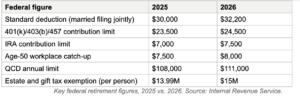
A handful of federal numbers changed for the 2026 tax year, and several directly affect retirees. These are the main changes to know about:
The Standard Deduction Went Up: For 2026, the standard deduction rose to $32,200 for married couples filing jointly, $16,100 for single filers, and $24,150 for heads of household.1 If you’re 65 or older, you also get an extra standard deduction on top of that, worth $2,050 if you’re single and $1,650 for each qualifying spouse on a joint return.
Retirement Contribution Limits Rose, and a New Roth Catch-Up Rule Started: You can now put up to $24,500 into a 401(k), 403(b), or governmental 457 plan, and up to $7,500 into an IRA (individual retirement account). The age-50 catch-up for workplace plans went up to $8,000.2 One new wrinkle: if you earned more than $150,000 from your employer last year, your catch-up contributions now have to go in as Roth (after-tax) money.
The Charitable Giving Limit From Your IRA Increased: If you’re 70½ or older, you can give money straight from your IRA to charity through a qualified charitable distribution, or QCD. For 2026, the yearly limit rose from $108,000 to $111,000.3
Non-Itemizers Can Now Deduct Some Charitable Gifts: Starting in 2026, even if you take the standard deduction, you can deduct up to $1,000 in cash gifts to charity, or $2,000 if you’re married filing jointly.1 New limits also apply to charitable deductions for people who do itemize, so how and when you give matters more.
The Federal Estate and Gift Tax Exemption Jumped: The amount you can pass on or give away before federal estate and gift tax kicks in rose to $15 million per person.1 This mainly matters for retirees with larger estates or big lifetime gifting plans.
Please note: The seven federal income tax rates did not go back up the way many people expected after 2025. They’re still 10%, 12%, 22%, 24%, 32%, 35%, and 37%, though the income ranges for each bracket adjust slightly each year. If you’d been planning around the old tax cuts expiring, that’s worth a second look.
How Illinois Retirement Taxes Apply to Your Retirement Income
A lot of this year’s changes happen at the federal level, but Illinois runs its own system for retirement income. In short, Illinois starts with your federal adjusted gross income and then lets you subtract qualifying retirement income before figuring your Illinois tax.
That gap matters. A source of income can count as taxable on your federal return and still get friendlier treatment on your Illinois return, so it helps to look at the federal and state sides separately instead of assuming they work the same way.
Retirement Income Illinois Continues to Exclude From Tax
Illinois lets you subtract the federally taxed portion of most common retirement income, which is a big reason the state is friendly to retirees. The subtraction depends on the type of income, not only your age.4
These are the main types of retirement income Illinois generally lets you subtract:
- Qualified Employer Plans and Pensions: The federally taxed part of pensions, 401(k)s, and other qualified employer plan payments can usually be subtracted on your Illinois return.
- IRAs and Self-Employed Plans: Federally taxable withdrawals from IRAs and qualifying self-employed retirement plans, like SEPs, generally qualify for the subtraction too.
- Social Security and Railroad Retirement: Any Social Security or qualifying railroad retirement benefits that are taxed federally can generally be subtracted for Illinois.
- Government Retirement Income: Qualifying government retirement and disability pay, including military retirement, and certain state or local government 457 deferred compensation, also generally qualify.
Income Illinois Can Still Tax After You Retire
Retirement, or reaching a certain age, doesn’t make all your income Illinois-tax-free. The subtraction is about the source and type of income, so some money is still fair game.
For example, if you keep working part-time or run a business, Illinois still taxes that income. So are the interest, dividends, and capital gains from a regular taxable brokerage account, which don’t become exempt just because you’ve retired.
Some payments also fall outside the retirement subtraction, like certain nonqualified deferred compensation and non-government disability plans. That’s why it helps to know exactly what kind of payment you’re getting before you count on it being tax-free in Illinois.
What Illinois Retirees Should Still Keep in Mind Alongside the New Rules
A few important federal rules didn’t change this year but still shape your decisions, so they’re worth keeping in view alongside the 2026 updates:
The Enhanced Senior Deduction Is Still Around: If you’re 65 or older, you can still claim a separate $6,000 federal deduction per qualifying person, or $12,000 if both spouses on a joint return qualify. It started in 2025 and runs through 2028, and it begins phasing out above $75,000 of modified adjusted gross income for singles and $150,000 for joint filers.5
Roth Conversions and Withdrawals Still Create Federal Tax: Illinois’s friendly treatment doesn’t erase the federal tax on traditional IRA withdrawals or Roth conversions. How much income you report federally, and when, still affects your overall tax bill, so it’s worth lining these moves up with the year’s deductions and brackets.
Social Security Can Still Be Taxed Federally: The senior deduction didn’t make Social Security federally tax-free. Depending on your combined income, part of your benefits can still count as federal taxable income, so an extra withdrawal or a conversion can raise more than the tax on that one move.
Tax Changes in 2026 for Illinois Retirees FAQs
1. Do Senior Citizens Have to Pay Taxes on Their Social Security in 2026?
Possibly, at the federal level. Depending on your combined income, up to 85% of your Social Security benefits can be federally taxable. Illinois, on the other hand, lets you subtract the Social Security that’s taxed federally, so you generally don’t pay Illinois tax on it.
2. What Retirement Income Is Not Taxed in Illinois?
Illinois generally lets you subtract the federally taxed portion of Social Security, pensions, 401(k)s, IRAs, railroad retirement, and government or military retirement. Income like wages, business income, and taxable investment gains is still taxed.
3. What Are the New Federal Tax Deductions for Seniors 65 and Older?
There are two to keep straight. The long-standing extra standard deduction for being 65 or older (for 2026, $2,050 if single or $1,650 per married spouse), plus the separate $6,000 enhanced senior deduction that runs from 2025 through 2028 and phases out at higher incomes.
4. What Changed for Catch-Up Contributions to Workplace Retirement Plans?
The age-50 catch-up rose to $8,000 for 2026. And if you earned more than $150,000 from your employer last year, your catch-up contributions now have to be made as Roth (after-tax) money when your plan offers catch-ups.
5. What Is the Qualified Charitable Distribution Limit for 2026?
It’s $111,000 per person, up from $108,000 in 2025. You have to be 70½ or older, and the money goes directly from your IRA to a qualifying charity.
6. What Is the Federal Estate and Gift Tax Exemption for 2026?
It rose to $15 million per person. That’s the amount you can pass on or give away during life before federal estate and gift tax applies.
Get Help Keeping Your Illinois Retirement Tax Plan Current
Some retirement tax rules change through new laws, others drift with inflation, and some stay put for years. For Illinois retirees, those federal updates also have to be read next to the state’s own way of treating retirement income.
Goldstone Financial Group can help you and others nearing retirement see how the current rules work together across your retirement contributions, withdrawals, Roth conversions, charitable giving, and Social Security, so no single tax provision gets looked at on its own.
Regular check-ins also let you adjust as federal thresholds, deductions, contribution limits, and other rules shift from year to year. If you’d like to see how the 2026 changes affect your own plan, you can schedule a complimentary consultation with Goldstone Financial Group.
Resources:
- Internal Revenue Service: Tax Inflation Adjustments for Tax Year 2026
- Internal Revenue Service: 401(k) Limit Increases to $24,500 for 2026
- Congressional Research Service: Qualified Charitable Distributions From IRAs
- Illinois Department of Revenue, Publication 120: Retirement Income
- Internal Revenue Service: New Enhanced Deduction for Seniors